
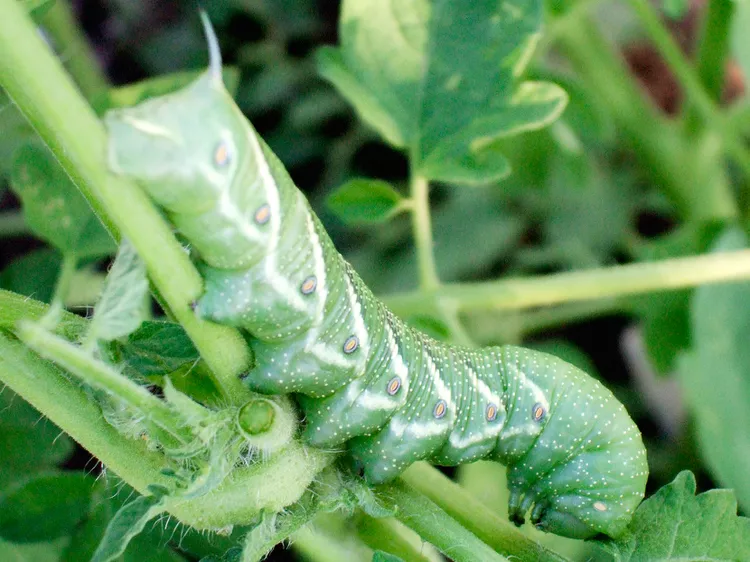
If you're at all squeamish about bugs in your garden, spotting a tomato hornworm on your plants might send you running from the vegetable patch. These plump caterpillars get about four inches long and can devour all the leaves on a tomato plant in a single day, but are completely harmless to humans. Even though tomato hornworms can get pretty big for a bug, they're masters at hiding in plain sight. Their green coloring is excellent camouflage as they crawl around your tomato plants. However, you'll want to keep an eye out for them so they don't ruin your tomato crop. These tips will help you know what to look for and how to get rid of tomato hornworms you may find.
What is a tomato hornworm?
A tomato hornworm is the larva of a hawk moth, also called a hummingbird moth. The moths emerge from the soil in late spring or early summer, then lay their eggs singly on the undersides of a host plant's leaves. The tiny caterpillars hatch in about a week and quickly grow as they feed. They reach full size in three to four weeks. Fully grown hornworm larvae will drop to the ground, where they burrow in and form a cocoon to turn into a moth.
What do tomato hornworms eat?
Tomato hornworms primarily eat the leaves of tomato plants, but they'll also devour potato, eggplant, and pepper leaves. They start feeding on the leaves near the top of a plant, creating leafless stems. Older hornworms will eat fruit too.
How to Get Rid of Tomato Hornworms
Identifying and removing hornworms from a plant early in their lifespan will help ensure you still get a bountiful tomato crop. As the caterpillars feed, they leave behind dark green or black droppings. The droppings tend to collect on lower leaves and are clearly visible. Check plants at least twice a week for feeding damage and droppings. If you see any, look closely until you spot the hornworms, which are usually nearby. The caterpillars feed continuously, so any time of day will work for going on a hornworm hunt.
The best way to get rid of hornworms is to pick them off the plant by hand. Drop the caterpillars in soapy water to kill them. Put on gardening gloves if handling bugs isn't your thing; remember, hornworms won't hurt you and they aren't poisonous. After you find a hornworm, continue searching for more of them once a day for the next 4 or 5 days. That way, you'll increase your chances of catching all of the caterpillars before they can do any major damage.
Pesticides are generally not necessary. Handpicking will usually control a tomato hornworm problem. Low risk pesticides (those that are least likely to harm non-target, beneficial insects like bees) include Bacillus thuringiensis (Bt), spinosad, and insecticidal soap. All three of these pesticides are most effective on small caterpillars and are only useful if the affected plants don't already have significant damage.
Preventing a Hornworm Infestation
Discourage hornworms from taking up residence by removing nearby weeds. Fewer weeds means fewer places for hornworm moths to lay eggs. Tilling the soil after harvest is another effective prevention strategy because it destroys burrowing caterpillars and their cocoons.
You can also rely on several natural enemies of tomato hornworms. Predatory insects, such as lady beetles and green lacewings, often eat hornworms in the egg stage, as well as young caterpillars. Tiny parasitic wasps (not harmful to humans) target hornworms as hosts. One telltale sign of their presence is a hornworm with what looks like white grains of rice sticking out of its back (shown above). Those are the cocoons of the wasp larvae that have fed on the caterpillar. New parasitic wasps will soon hatch out of them, so leave any parasitized hornworms in place. Help out these hardworking, beneficial insects by avoiding pesticide use.